
Indirect Land Use Change: The Theory that Became Law
Biofuels, models, and the challenge of measuring what can’t be seen

Too long, didn’t read:
Indirect land use change (ILUC) was born from a good idea: preventing deforestation linked to global biofuel demand.
The models used to estimate ILUC rely on economic theory, not measurable land conversion.
A risk-based approach keeps the goal intact while grounding policy in observable reality.
Land use change defined
Land use change has been a highly debated topic for nearly twenty years. It’s a lingering aspect of renewable fuel policy, and rulemaking goes back and forth on penalties included for indirect land use change (ILUC). Many people were first introduced to the concept in 2008, when Princeton researcher Timothy Searchinger published a paper suggesting that biofuels might be worse for the planet than fossil fuels. His logic stated that if U.S. grain acres shift from food to fuel, global markets respond. Higher prices encourage farmers abroad to plow up grasslands or forests to replace the lost supply. Even if biofuels shrink emissions at home, they could spark deforestation abroad.
This idea caught on with government officials and nongovernmental organizations alike. Rulemakers assigned carbon intensity penalties based on the idea. Farmers and ethanol producers suddenly found themselves on the hook for emissions from land they’d never seen. But ILUC has always been more theory than fact. The models rely on economic guesses about how distant farmers might behave, not on measurable, observed data. Furthermore, it’s almost impossible to prove that a farmer in Brazil leveled part of the forest as a result of the actions of a farmer in Iowa. And fifteen years later, the policy still hasn’t caught up with that lack of evidence.
Before we dig into why that matters, it’s worth defining the terms. Direct land use change happens when land use physically shifts, for example, grass to crops, or crops to pavement. Indirect land use change tries to capture the ripple effect. It’s the idea that when a grain is redirected to biofuel production in one part of the world, it triggers farmers in other parts of the world to make up for the loss by deforesting acres to produce grain for food. Land use change is the umbrella that includes both direct and indirect effects.
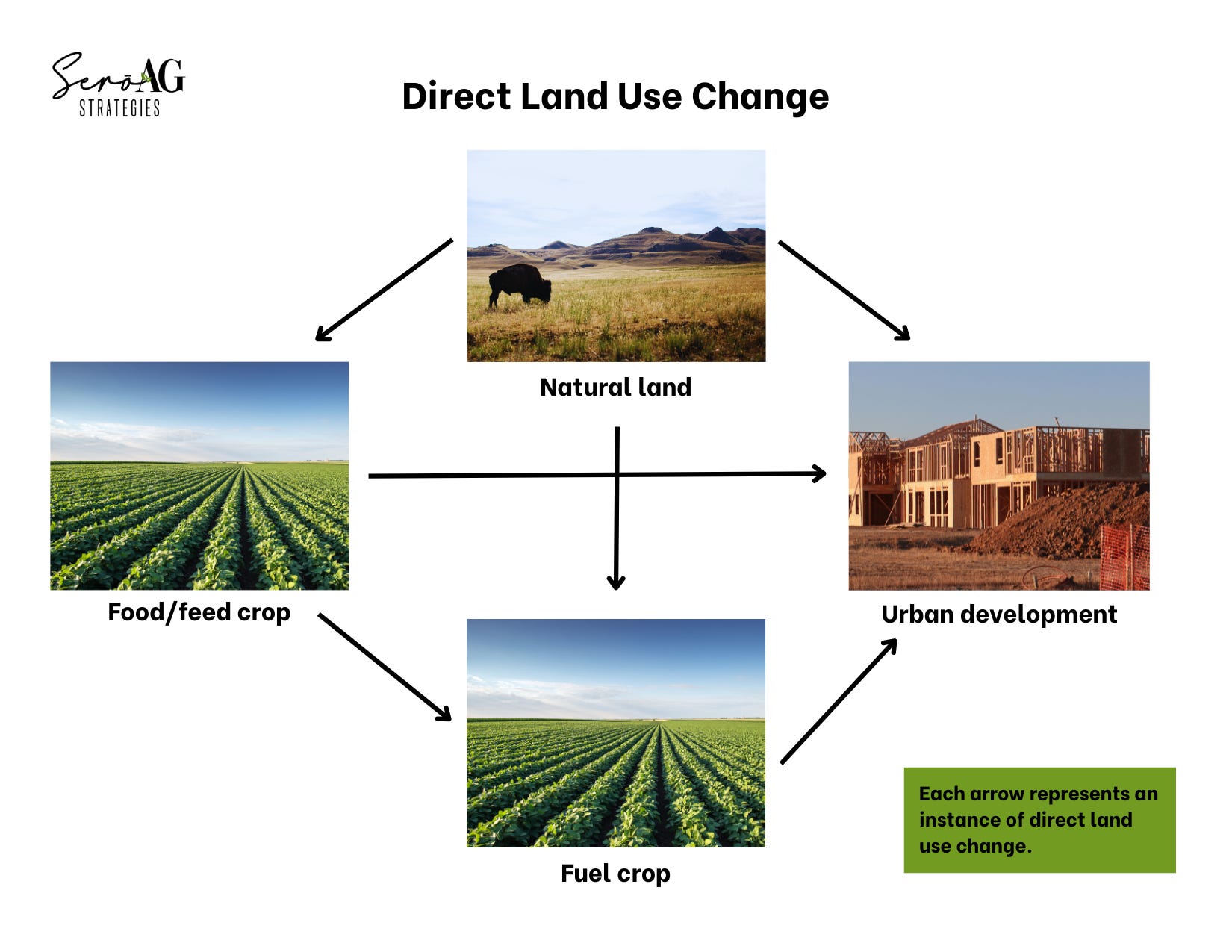
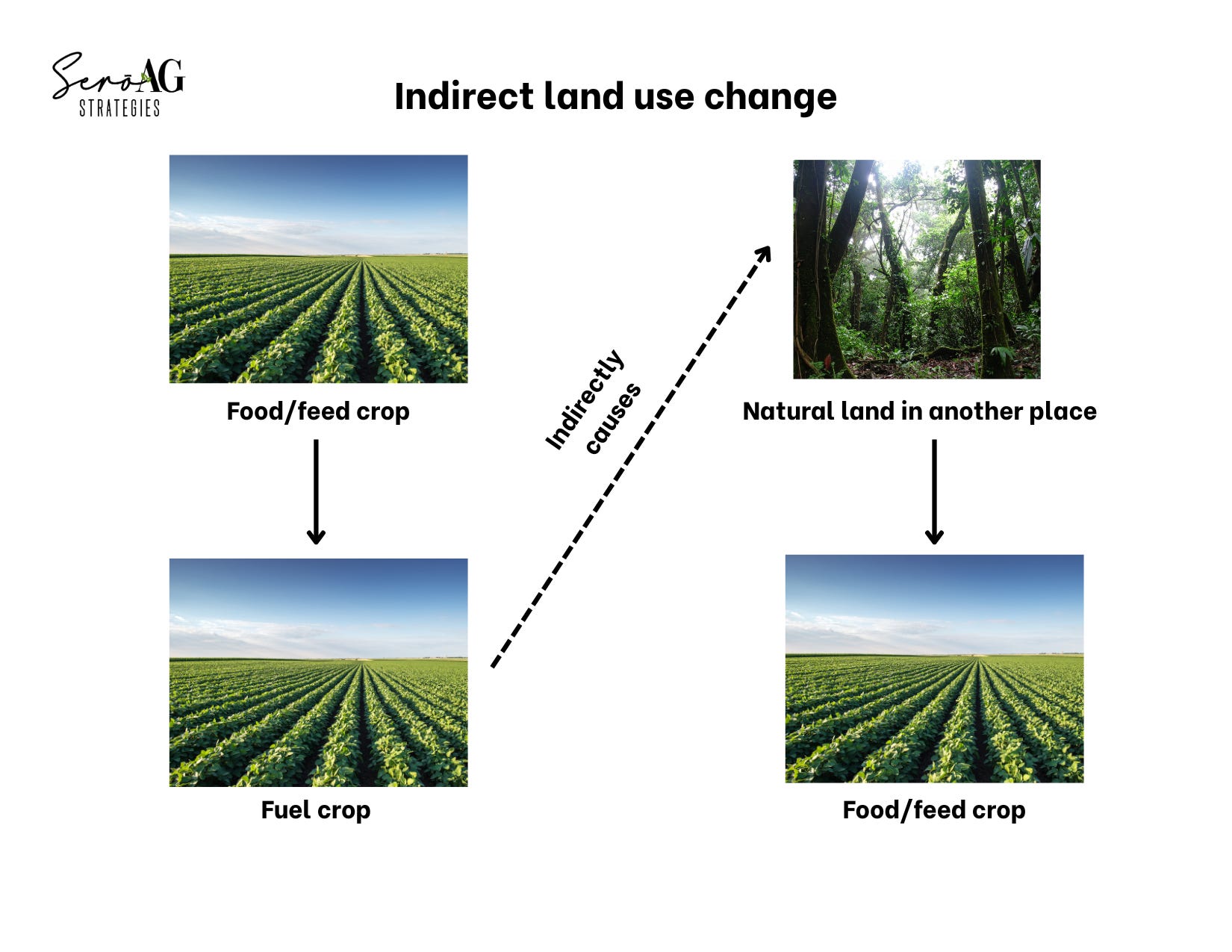
As you can see, we’re talking about many things when we say “land use change.” The concept brings with it many questions and a lot of frustration for domestic farmers. While we can appreciate the sentiment of wanting to stop deforestation, this is a fraught path toward that end.
When an idea becomes legislation
When Congress expanded the Renewable Fuel Standard (RFS) under the Energy Independence and Security Act of 2007, the goal was to reduce dependence on foreign oil and cut greenhouse gas emissions through biofuel use. To ensure the program delivered actual climate benefits, lawmakers required the EPA to calculate the lifecycle emissions of each fuel pathway. That directive opened the door for the idea of indirect land use change to enter the policy conversation. Around the same time, Searchinger’s 2008 paper made national headlines. Environmental groups seized on the theory, framing ILUC as the hidden cost of biofuels. Policymakers who were eager to appear cautious about unintended consequences adopted the concept before the science had matured. When EPA finalized the RFS2 rule in 2010, it included modeled ILUC emissions in the carbon intensity scores used to determine which fuels qualified as “renewable.”
That decision was a watershed moment. It cemented a theoretical construct into federal regulation, turning economic forecasts into compliance penalties. To justify the inclusion, EPA relied heavily on early versions of models like GTAP and FAPRI, which attempted to simulate how global agriculture might respond to increased biofuel demand. But even at the time, those models produced significantly different outcomes, some showing major land conversion, others showing minimal change. Rather than treating ILUC as an open research question, regulators treated it as a known quantity, effectively baking uncertainty into the law. The result was a system that burdened biofuels with hypothetical emissions while giving fossil fuels a pass on their own indirect effects, such as geopolitical instability or long-term land degradation from extraction. In short, ILUC became policy not because it was proven, but because it was politically convenient at a moment when environmental advocates and regulators aligned.
How land use change is calculated – models upon models
The most straightforward answer for calculating land use change is: land use change equals direct land use change plus indirect land use change. But of course, it’s a bit more complicated than that.
Direct land use change is calculated using measurable data on how land physically shifts from one category to another. Analysts use satellite imagery, land cover databases, and field surveys to quantify the number of acres converted. Those acreage changes are then paired with known carbon stock values for soil and vegetation to estimate emissions or sequestration. The result is a calculation grounded in observed evidence of actual land conversion multiplied by carbon flux per acre.
Indirect land use change is calculated through economic modeling, usually using computable general equilibrium (CGE) or partial equilibrium (PE) models. CGE models simulate how the entire global economy adjusts to policy or market shifts, linking agriculture with energy, trade, and manufacturing. Partial equilibrium (PE) models narrow that focus to agriculture alone, using market data to estimate how production and trade might respond. Land use and emission accounting models estimate how changes in land cover or management affect greenhouse gas emissions, combining spatial data, crop and soil parameters, and carbon stock values to quantify the climate impact of agricultural or policy-driven land shifts. Econometric models analyze historical data while spatial and biophysical models map how land could change based on physical factors. Hybrid models combine some number of these other models for a more nuanced approach. Together, all of these represent different ways of answering the same question: how markets, people, and landscapes react when demand for crops shifts. But none yet offer a definitive, measurable picture of indirect land use change. Let’s now dive into some specific models that address land use change (not a full list, but a good starting point).
The Global Trade Analysis Project (GTAP) and its Agro-Ecological Zone Emission Factor (AEZ-EF) model are often used together to estimate indirect land use change (ILUC). GTAP is a global economic model that simulates how production, trade, and land allocation might respond to policy shocks like increased biofuel demand. Its outputs, however, rely on assumed elasticities and market theory rather than observed land behavior. AEZ-EF converts GTAP’s projected land shifts into carbon emissions by dividing the world into climate- and soil-based zones, each with its own emission factor. While AEZ-EF adds spatial detail, its results are only as reliable as GTAP’s hypothetical inputs.
Other models emphasize real-world calibration over global theory. The Food and Agricultural Policy Research Institute (FAPRI) model uses historical agricultural data to simulate market responses, producing more conservative and intuitive ILUC estimates but missing cross-sector feedback. The Forest and Agricultural Sector Optimization Model (FASOM) builds on FAPRI data to project how U.S. producers shift land among crops, pasture, and forests, offering detailed national insights but limited global reach. The Carbon Calculator for Land Use and Land Management Change from Biofuels Production (CCLUB) translates modeled land changes, often from GTAP, into carbon outcomes using regional soil and biomass data. Linked to GREET, it ties land use emissions to full fuel life cycles, but like AEZ-EF, its accuracy depends on the validity of its input scenarios.
All of these models share a common flaw. They depend on each other’s assumptions more than on observed evidence. Economic models generate hypothetical land shifts, and carbon accounting tools convert those projections into emissions, layering uncertainty on top of uncertainty. The result is a chain of inference that drifts further from reality with each link. Yet each model continues to shape how policy is made. GTAP underpins EPA’s and CARB’s official lifecycle analyses, making it the foundation of regulatory carbon accounting. AEZ-EF translates those GTAP outputs into the emission factors that ultimately determine whether a biofuel meets federal carbon-reduction thresholds. FAPRI guides USDA and congressional projections of how crop prices and acreage respond to biofuel demand, influencing perceptions of market impact. FASOM informs U.S. land and forestry policy, helping estimate domestic carbon stocks under different land-use scenarios. And CCLUB, tied to the GREET model, links all of that back to the final lifecycle emission scores used in fuel policies like the Low Carbon Fuel Standard in California. Together, they form the scaffolding of modern biofuel regulation. Models feeding models until theoretical assumptions become enforceable policy. After more than a decade of refinement, the science of indirect land use change still rests on models built to explain theory, not to measure fact.
How modeling breaks down into uneven, unfair penalties
The first flaw lies in how ILUC modeling assigns carbon penalties unevenly across countries and crops. Under the frameworks used by EPA and California’s Air Resources Board, Brazilian sugarcane ethanol typically carries a lower indirect land use change penalty than U.S. corn ethanol, even though deforestation and grassland conversion in Brazil are well-documented and ongoing. The models assume that when U.S. crops are used for fuel, global demand shifts production to places like Brazil, where farmers clear land to grow crops for food. Yet when Brazilian sugarcane is used for ethanol, that expansion is treated as a lower risk. The result is an upside-down logic where American farmers are penalized for theoretical land clearing abroad, while producers in countries with active deforestation are rewarded with lower carbon scores.
Second, the policy implication creates an unfair competitive advantage. Because ILUC penalties feed into carbon-intensity scores, they influence market access, credits, blending requirements, and export viability. When Brazilian sugarcane ethanol carries more favorable scores, it effectively gains preferential treatment in both domestic and international biofuel markets. At the same time, U.S. ethanol is burdened with higher assumed emissions even though the actual empirical chain of “U.S. crop → global crop shift → deforestation” is tenuous at best. Some analysts have pointed out that regulators continue to apply relatively large ILUC penalties despite mounting evidence that the primary land-use response globally has been increased efficiency rather than massive new conversion. Moreover, U.S. grain production has consistently outpaced demand, with record yields and stable acreage across corn, sorghum, and other ethanol feedstocks. Even as a share of these crops goes to biofuel, carryout stocks remain high and exports struggle to clear the surplus. There is no evidence that diverting grain to ethanol causes food shortages or new land conversion when the U.S. continues to produce more grain than the market can absorb. All of this means U.S. farmers and biofuel producers shoulder model-based liabilities while facing tougher market conditions.
Finally, this logic collapse undermines the credibility of the entire regulatory structure around ILUC. If models treat the same feedstock differently depending on geography, then policy ends up penalizing or rewarding stakeholders based more on where they operate than what they do. That’s a fundamental logical problem that demands policymakers recalibrate how indirect land use change is handled if the goal is fairness and accuracy.
The intent isn’t the issue
It’s important to say this plainly: the people who first pushed for indirect land use change penalties weren’t wrong to care. The idea came from a good place. If land expansion in one part of the world really does undo the carbon savings of biofuels somewhere else, then it should be part of the climate accounting. That logic is sound in theory. The trouble is that indirect land use change isn’t something we can observe.
It stands to reason that land use change could cause emissions elsewhere. Markets are connected, and agricultural decisions in one country ripple through the global system. But the further those ripples spread, the harder they are to trace back to a single cause. That’s where ILUC modeling breaks down. It tries to pin global cause and effect to one variable in a noisy, adaptive system shaped by weather, policy, technology, and human behavior. Even the most sophisticated models can’t separate one signal from the rest without leaning on speculation.
So while the principle behind ILUC reflects a serious concern, the practice of turning it into a policy penalty does more harm than good. In fact, one study looked at the social implications of an ILUC penalty and found that adding ILUC penalties to biofuel policy delivers little additional climate benefit for the cost of higher fuel prices, reduced biofuel investment, and lost emissions savings from displaced fossil fuels..
A better way forward
There’s a smarter way to deal with the risk of indirect land use change without pretending we can calculate it precisely. A risk-based approach, like the one already used in Canada and reflected in the European Union’s Renewable Energy Directive III (RED III), shifts the focus from speculative modeling to measurable safeguards. Instead of assigning blanket carbon penalties based on global assumptions, regulators evaluate the likelihood that feedstock production in a given region contributes to deforestation or habitat loss. Low-risk pathways, including those grown on existing cropland or under certified sustainability systems, qualify without penalty. High-risk pathways, such as those linked to new land conversion, face tighter scrutiny or are simply excluded.
This approach keeps the intent of ILUC modeling intact. It still discourages land conversion, but grounds it in observable criteria rather than theoretical linkages. Canada’s Clean Fuel Regulations already use this framework, requiring biofuel producers to demonstrate that their feedstocks come from established agricultural land rather than newly cleared areas. The EU’s RED III builds on the same concept, flagging “high ILUC-risk” crops and rewarding verified “low-risk” supply chains. Both systems acknowledge that risk exists but stop short of pretending to know exactly how much carbon it represents.
A risk-based model offers fairness, transparency, and real-world accountability. It recognizes that not all production carries equal risk and that data should drive regulation. In doing so, it keeps global markets open to sustainable biofuels while closing the door on practices that genuinely threaten forests and grasslands. That’s how you address land use change without punishing the farmers and ethanol producers who are part of the solution.
Rethinking the path
At its core, indirect land use change began as a moral question: how do we make sure solving one problem doesn’t create another? That question still matters. But after fifteen years of modeling, debate, and shifting penalties, it’s clear that the way we’ve tried to answer it hasn’t worked. The models built to measure ILUC have become more precise in form but not in truth. A risk-based framework offers a way out: it keeps global accountability on the table while returning fairness, logic, and observation to the center of the conversation. If policy is meant to follow evidence, not imagination, then it’s time we build a system that does the same.
Recent Articles
Check out the latest edition of Sorghum Grower Magazine!
Sorghum summit sparks new international trade relationships in Kansas Farmer
Will there be a third generation? Why sorghum might hold the answer in Kansas Farmer
U.S. sorghum exports to China plummet 97% in Kansas Farmer
If you haven’t already, check out our previous newsletters.
About Serō Ag Strategies
At Serō Ag Strategies, we bridge farmers and supply chain partners by transforming complex agricultural data and policy into actionable insights. We also work to create and grow markets for commodity crops by aligning production with evolving demand, policy shifts, and sustainability goals. Combining multinational expertise with the personal touch of boutique consulting, we specialize in economic and sustainability analysis that drives strategic innovation.
Click here to learn more about Serō Ag Strategies.